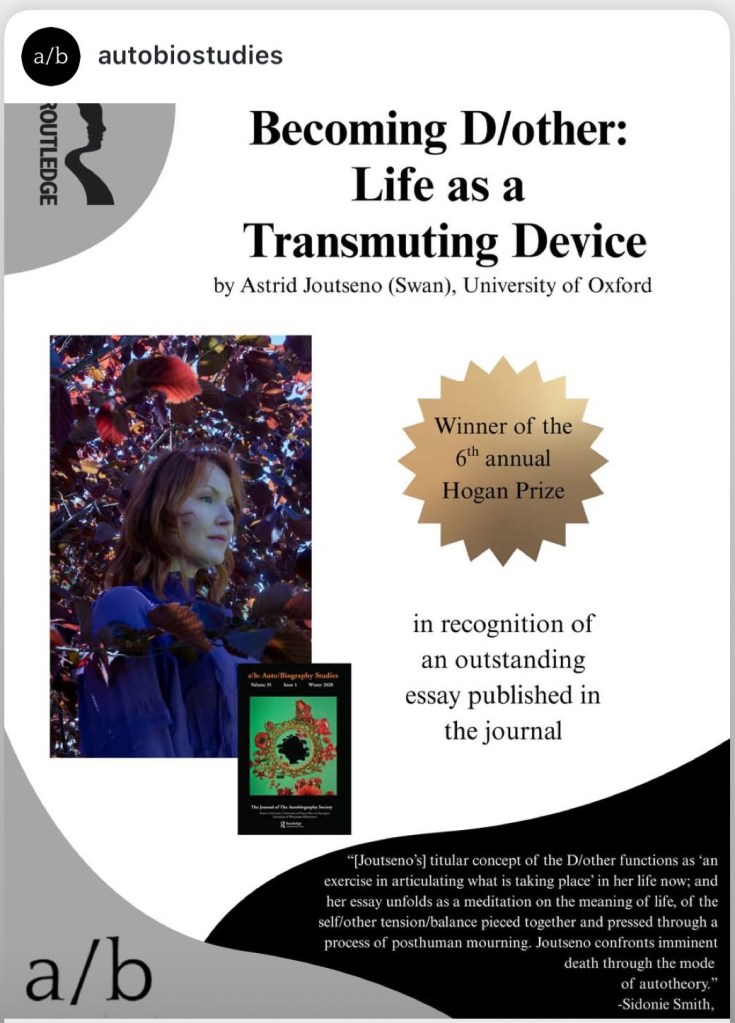
a/b Auto/biography Studies has awarded me the 6th annual Hogan Prize. This award is given for an outstanding essay published in the journal. My essay “Becoming D/other: Life as a Transmuting Device” (a/b: Autobiography Studies, 35:1, 81-96, 2020) was selected by the acting judge, Sidonie Smith, who happens to be a grand old lady of life writing studies and one half of the pair Smith & Watson to whom I must have made more references in my research publications than anyone else.
Sidonie Smith’s comments on the essay will be published in the 40th Anniversary issue of the journal, but here is a little quote from her:
[Joutseno’s] titular concept of the D/other functions as ‘an exercise in articulating what is taking place’ in her life now; and her essay unfolds as a meditation on the meaning of life, of the self/other tension/balance pieced together and pressed through a process of posthuman mourning. Joutseno confronts imminent death through the mode of autotheory.
Surprise!
Winning something I did not know I was nominated for is strange. So is getting an award for an essay I wrote many years ago. I am not entirely sure, but I assume that the journal has resumed giving out the award after a Corona pandemic induced break (?) and is therefore honoring such “old” writing. It makes me happy to learn that published writing (and thinking as well as other arts and efforts) has a different temporality to the writer’s. This essay may be only beginning to spark something, to intermingle. Meanwhile, I thought such moment had already been determined to never exist. Yet, what we put out to the world has a life and a resonance that moves at its own pace.
D/other is a concept I articulated during my PhD research (this essay was the expression of that as part of my PhD), and then explored musically on my album D/other published in 2021. Since then I have struggled to return to it and to continue working with it. Still, I have held the intention to keep developing it, but new directions and a sense of difficulty have persisted. New layers have settled. Maybe friction or a slowness occurred because D/other was a concept born out of an urgency, the threshold of death. It is taxing to live there.
As I have been exploring grief during the last years, the concept of D/other has hovered nearby and I have continued my earthy living under a rule of uncertainty, deepening my acquaintance with grief and its many manifestations both via researching the grief of the dying and via experiencing it. So I continue, against the odds – past my own expectations and past conservative estimations in medicine. For now. The threshold from where I wrote the prize-winning essay has become more familiar to me – maybe larger as a space and more porous. I escape it by hiding in the everyday, but I return to it all the time both out of will and without a choice.
At a Time of Genocide
I write during a genocide of the Palestinian people, yet, I live everyday as if in peace, disturbed only by the discomfort of not doing enough to help. Meanwhile a Swedish real-life Pippi Longstocking is making her way to Gaza to witness and to carry aid to the most needy. I can hear the questions echoing in from the future: why didn’t you do anything to stop this? How could this happen? What will be the outcome?
Lawrence Langer writes about “the afterdeath” state of the people who lived through the Holocaust in camps and ghettos and then went on living, but also carrying death – forever changed and damaged – forever split. Langer has argued again and again that survival isn’t hopeful, it isn’t inspiring. He cautions against narratives of hope drawn from extreme human suffering, the so-called survival: to gloss over the scale and result of human will to murder and cause suffering in order to tell a narrative of hopefulness is to allow for detachment. But can anyone afford detachment when Langer reminds that hunger means looking at another person to evaluate which part of them is edible?
Grieving is to not turn away from the horror, to resist actively. Single lives matter. Stories of lives matter. This is a time when Langer’s suggestion resonates: there is no “we” and a focus on the individual story of a person’s experience is of the highest value. A generalization leads to dehumanization.
I thank Sidonie Smith, the a/b Auto/Biography Studies editors and the special issue Life Writing in the Anthropocene editors Jessica White and Gillian Whitlock. My essay was written in Helsinki University. At the time of receiving the Hogan Prize I am a researcher at University of Turku and a visiting scholar at Oxford Life-Writing Centre, Oxford University.
References and Links
Langer, Lawrence L., 2021. The Afterdeath of the Holocaust. Palgrave Macmillan
Huttunen, Katariina, 2021. Jälkikuolema. S&S.
“Lawrence L. Langer: A Life in Testimony”, 2019. Joshua M. Greene; Shiva Kumar; Michael Berenbaum, https://fortunoff.library.yale.edu/film/langer/
Joutseno, Astrid, 2020. Becoming D/other: Life as a Transmuting Device, a/b Auto/Biography Studies, 35:2, pp. 81-96.
https://doi.org/10.1080/08989575.2020.1720180
 Astrid Swan
You must be logged in to post a comment.